Busan
Nam Gyeongsang
Brit in Seoul · CC BY-SA 4.0
Korea's biggest port city — beaches, fish markets, hillside villages and nightlife at the water's edge.
Busan is stretched between mountains and sea, so the city is always climbing or descending. Morning at the Jagalchi fish auction, midday lost in the coloured lanes of Gamcheon, afternoon flat out on Haeundae, evening at Gwangalli watching the bridge change colour. People here speak with a heavy accent, eat spicier and saltier than Seoul, and are proud of dwaeji-gukbap — pork bone soup with rice, a dish born of the refugee years. Each October the city runs on the rhythm of the Busan International Film Festival.
Best time to visit: May–June and September–October
Local specialties
- Dwaeji-gukbap
- Milmyeon noodles
- Busan fish cakes
- Seed hotteok
Places (14)
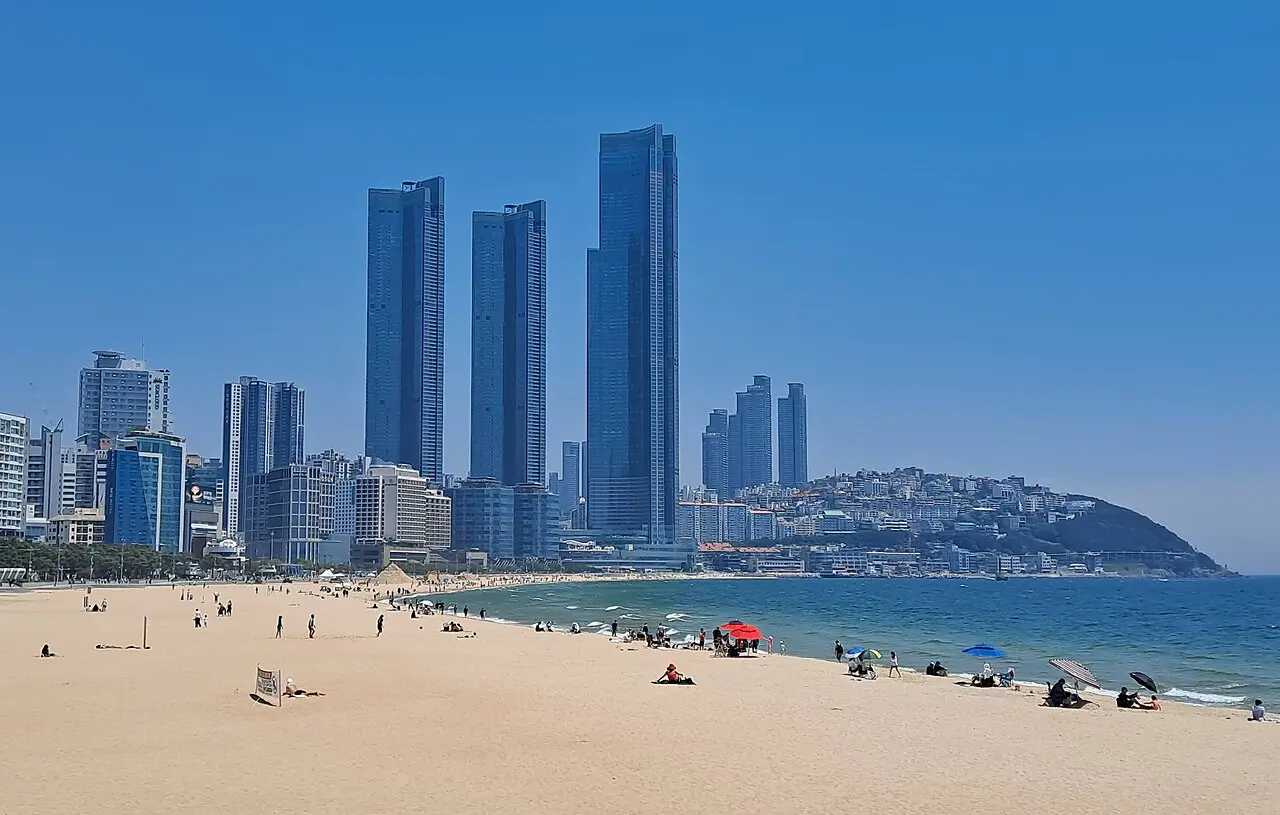
Haeundae Beach
Korea's most famous beach, a crescent of golden sand under a wall of high-rises.
Gamcheon Culture Village
Stepped houses painted in every colour on a hillside, once a refugee settlement, now an art village.
Songdo Beach & Marine Cable Car
Korea's first public bathing beach, now crossed by a glass-floored cable car straight over the bay.
Gwangalli Beach & Gwangan Bridge
A beach facing a two-tier suspension bridge, where Busan flies drones and fireworks every weekend.
Beomeosa Temple
A 1,300-year-old head temple under Geumjeongsan, on the very edge of the city.
Haedong Yonggungsa Temple
A rare temple built at the water's edge rather than in the mountains, catching Busan's first sunrise.
Jagalchi Fish Market
Korea's largest seafood market, where you pick your fish downstairs and eat it upstairs.
Yongdusan Park & Busan Tower
A hill in the old quarter reached by outdoor escalator, topped by a tower over the whole harbour.
Huinnyeoul Culture Village
A run of white houses clinging to Yeongdo's sea cliff, with a narrow path running right above the waves.
Bosu-dong Book Street
A narrow lane of a few dozen second-hand bookshops, stacked floor to ceiling since the war years.
Oryukdo Skywalk
A glass deck jutting out from the cliff, above the point where the Yellow Sea and the Sea of Japan officially meet.
Busan Cinema Center
An 85-metre unsupported cantilever roof covered in LEDs — home of the Busan film festival.
Taejongdae
The rocky headland at the end of Yeongdo, where sheer cliffs drop straight into the sea and a white lighthouse stands alone.
Igidae Coastal Walk
A path over volcanic rock along the shore, facing the wall of Haeundae towers across the bay.