Gyeongbuk
Bắc Gyeongsang
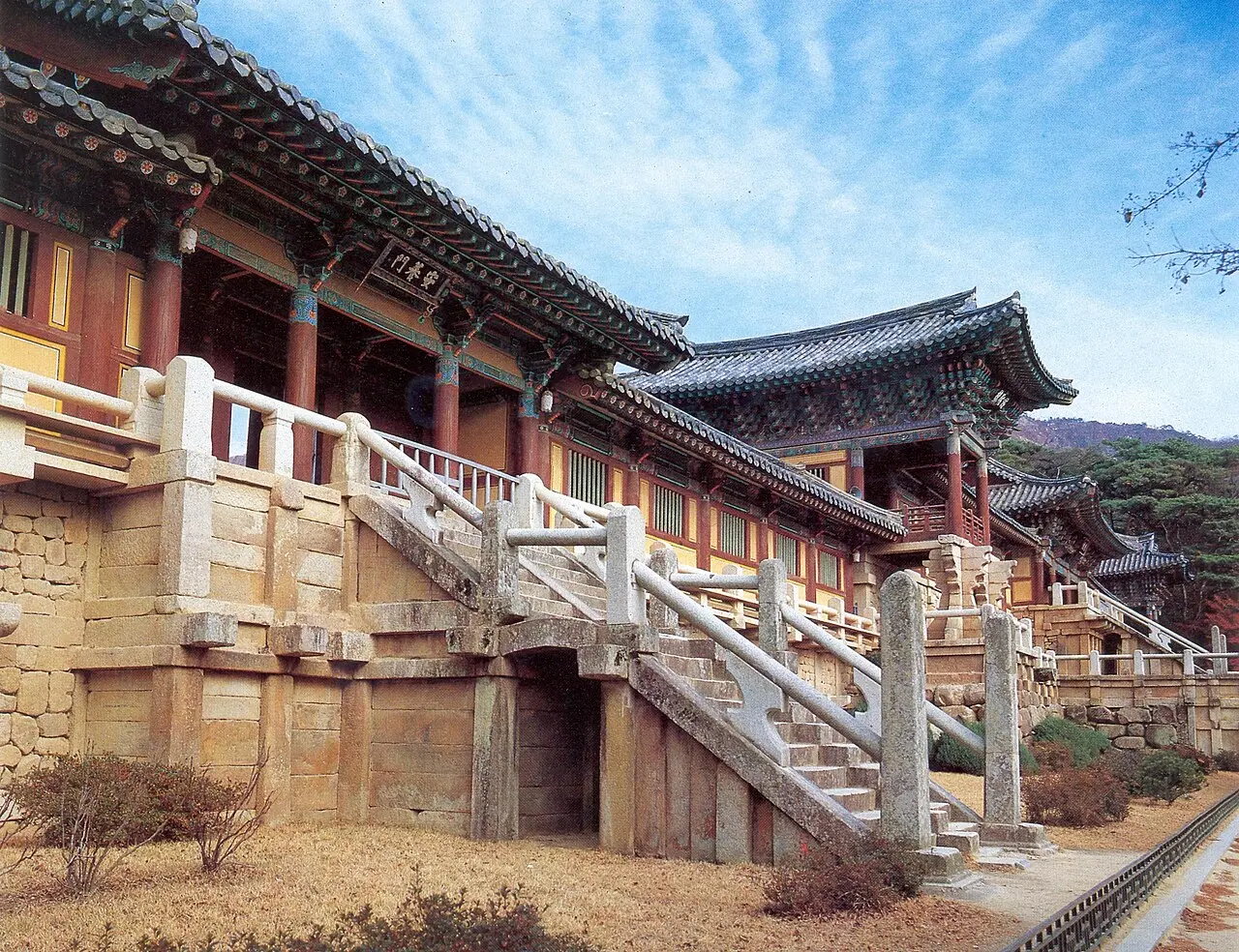
Unknown authorUnknown author · Public domain
The cradle of the Silla kingdom and Korean Confucianism — Gyeongju, Andong and villages still lived in.
North Gyeongsang is where Korean history lies thickest. Gyeongju was the Silla capital for nearly a thousand years, and the city today is an open-air museum: royal mounds among the streets, a 7th-century observatory, Bulguksa temple and the Seokguram grotto on the mountain. Further north, Andong keeps Hahoe village and its Confucian academies, where clan rites are still genuinely practised rather than performed for visitors. In between are mountains, old temples and rock gorges like Juwangsan.
Best time to visit: April (cherry blossom) and October–November
Local specialties
- Andong jjimdak
- Andong salted mackerel
- Gyeongju rice bread
- Andong soju
Places (15)
Bulguksa Temple, Gyeongju
The masterpiece of 8th-century Silla Buddhist architecture, with two stone stairways to the 'Buddha land'.
Buseoksa Temple, Yeongju
Korea's oldest wooden building, its swelling columns holding a roof above range upon range of mountains.
Donggung Palace & Wolji Pond
A Silla palace pond dug in the 7th century, three halls reflected at night in water like glass.
Daereungwon Tomb Complex
Twenty-three Silla royal tombs rising out of the city like enormous grass hills.
Hahoe Folk Village, Andong
A Confucian village wrapped in a loop of river, where the Hahoe masks were born.
Gyeongju National Museum
Home of the Silla gold crowns and of Korea's largest bronze bell, cast for a dead king's soul.
Woryeonggyo Bridge, Andong
Korea's longest wooden footbridge, built after a letter and a pair of woven shoes were found in a grave.
Seokguram Grotto
A granite Buddha in a man-made cave on a mountain top, facing straight out to the East Sea.
Yangdong Folk Village
An intact Joseon clan village on a hillside — the gentry above, their tenants below.
Homigot Cape, Pohang
The easternmost point of mainland Korea, where a giant bronze hand rises out of the sea to catch the New Year sun.
Bunhwangsa Pagoda & Hwangnyongsa Site
Korea's oldest stone pagoda, beside an empty field that was once East Asia's largest temple.
Dosan Seowon Confucian Academy, Andong
The academy of Yi Hwang — the face on the 1,000 won note — beside a still lake.
Juwangsan National Park
A gorge of vertical rock with three waterfalls — the smallest national park in Korea, and the most dramatic.
Cheomseongdae Observatory
East Asia's oldest surviving astronomical observatory, built in the 7th century from 362 stones.
Ulleungdo Island
A volcanic island nearly three hundred kilometres offshore, ringed by cliffs with almost no flat ground.